

The legend of John Henry is becoming all too real for university students.
John Henry, a powerful steel driver, fought against a steam-powered rock drill in a race to build a railroad. John Henry won the race against the machine in a show of the indomitable human spirit and resistance against industrialization, but died from exhaustion as soon as the competition ended.

Many university students find themselves living their own version of the story as generative AI usage rises.
Generative AI is a type of artificial intelligence that produces new content from a prompt. It is typically used in higher education to create images, text, code and video. The technology uses massive datasets and deep machine learning to scour the internet for content to base its creations on.
The use of generative AI in education is controversial. Because the technology can generate a complete response to an assignment with a simple prompt, it can enable plagiarism and threaten academic integrity.
At the University of Northern Colorado, the use of generative AI is not entirely prohibited. Professors are allowed discretion with the technology, and can give students permission to use it.
Though many professors ban generative AI, that doesn’t stop students.
Using generative AI has become the norm for many students. ChatGPT is the most popular AI platform to use, as it can generate human-like responses for essays, solve math equations and provide quick summaries for readings. ChatGPT pulls information from across the internet to generate its quick responses, but not all of the answers it provides are accurate.
However, generative AI is not completely used as a replacement for work. Many students use it as a tool to help with studying.
Quinten Riggs is a second-year Spanish education major. He uses generative AI to create study guides and condense long assigned readings into summaries.
“The rise and future use of AI is inevitable, and I need to be prepared to use it as the tool it is rather than the crutch most others in academia use,” Riggs said. “I see AI being used to take away a lot of the grunt work we currently have.”
This sentiment is shared by many college students beyond UNC.
Llesica Escobar is a first-year nursing student at Front Range Community College. Escobar also uses generative AI to help with studying.
“I feel like it's really useful, like, if you want it to help you with your homework,” Escobar said.
However, many students are also frustrated with their peers' use of generative AI as a replacement for schoolwork.
“I believe everyone should be frustrated with the people who use it to complete their work,” Riggs said.

Angelo Sotelo is a first-year business major at FRCC. He works multiple jobs and attends school part time. Sotelo is annoyed by AI usage in schools.
“It makes me frustrated just because they're not putting the work in,” Sotelo said. “They're going to go out to this world, do their thing and they're not being prepared for it.”
Sotelo stated that AI can be a useful tool for studying, but that many students don’t use it that way.
“I mean, yeah, AI is pretty cool,” Sotelo said. “But then you get people just straight up cheating with it."
This sentiment is shared by Escobar.
“I feel like if you use it, then, like, what are you learning, honestly?” Escobar said.
Aaron Ortega, a second-year computer science major at Colorado State University, also sees the benefits of AI, but is concerned over how AI is being managed and marketed toward the public.
“I worry about AI usage,” Ortega said. “Yes, AI is getting better every day, but companies are only seeing the profit and looking past some glaring problems.”
Generative AI is powered by AI data centers, which can use five to 10 times more power than traditional data centers. As energy is consumed by the centers, carbon emissions increase, creating a significant environmental impact.
Furthermore, there are concerns over water usage with the centers. Many centers are liquid-cooled, which requires large amounts of high-quality freshwater to stay functional. According to NPR, a large data center can use nearly five million gallons of water daily.
Ortega is also worried about the impact AI will have on humans.
“The environmental impacts of the data centers, bad,” Ortega said. “Relying on it too heavily to the point where we forget how to do things ourselves, bad.”
According to the Duke Center for Teaching and Learning, overreliance on AI can reduce critical thinking and cause poorer reasoning and argumentation skills.
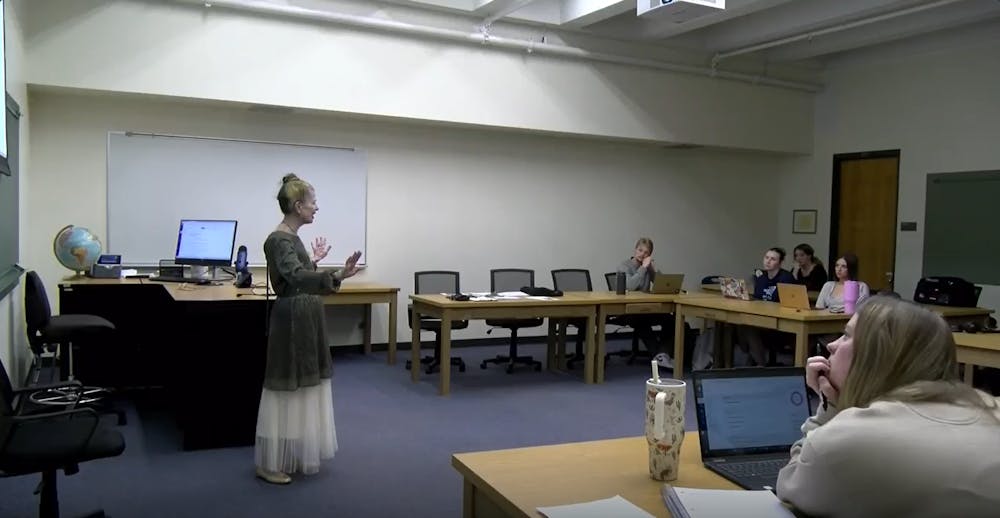
Lin Allen is a communications professor at UNC. She has studied AI for several years, and teaches students how to use generative AI as a tool rather than a replacement.
“When we’re focused specifically on AI, I think it’s refreshing for students to not just have the ‘thou shalt nots’ about what they are to avoid,” Allen said in an interview with BearNews. “But actually realizing that these technologies are becoming a part of our world.”
Allen teaches how to work with AI, rather than for AI. Students learn about AI’s role in today's society, and how to adapt with AI and use it correctly, rather than just allowing the technology to take complete control of their work.
Allen summarized her lessons in just five words.
“Don’t let it use you,” Allen said to Bear News.

To Intern or Not to Intern

From Blank Space to Personal Place


