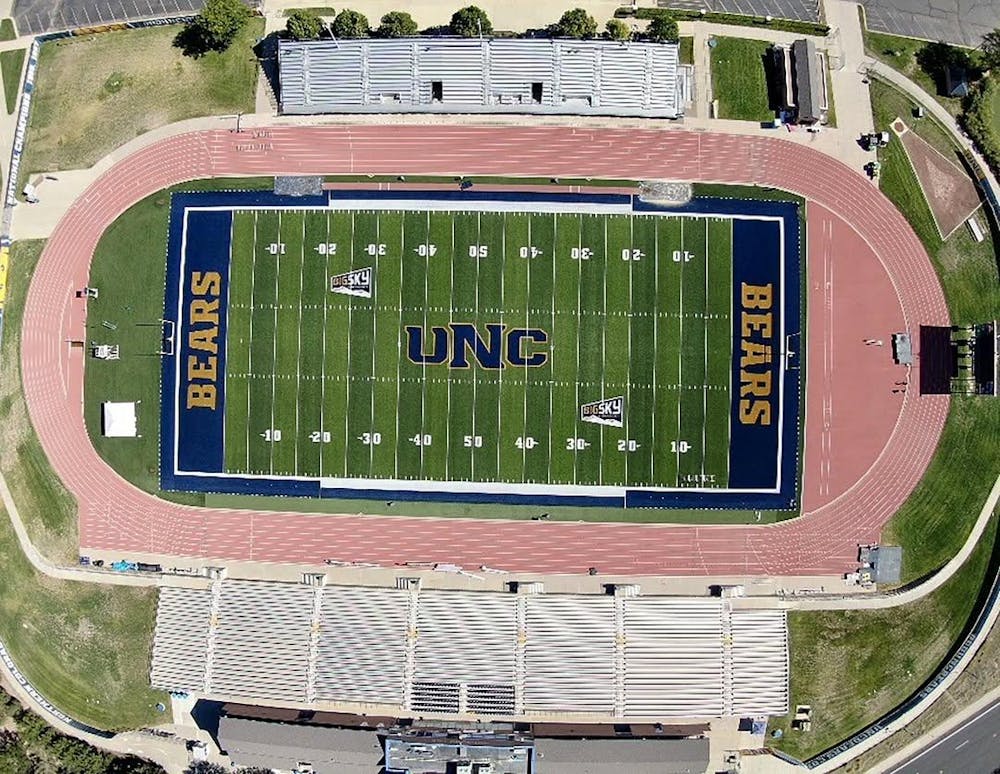
Nottingham Field is the home of UNC Bears football and has been for the past 30 years. Photo credit: Jim Rydbom/Greeley Tribune
The sports programs at the University of Northern Colorado have been on the rise in recent years. The school is home to Big Sky champions in men’s basketball, women's volleyball and softball, and even the football team showed progress. This season, the Bears football team finished 4–8, which is their best record since 2016.

With football trending upward, it may be time for UNC to invest further in the athletic department. A simple and meaningful starting point would be adding lights to Nottingham Field.
Compared to other Big Sky stadiums, UNC’s facility is behind the curve. Northern Arizona, Idaho and Idaho State all play in indoor stadiums, while programs like Montana, Cal Poly and Weber State have fully lit outdoor fields. Even Portland State, which uses a city-owned facility, plays under lights. In Colorado, Nottingham is one of only two college football stadiums without lights, the other belonging to Fort Lewis, a Division II school in Durango.
While Nottingham meets UNC’s current needs, night games have become a marquee feature across college football. They increase visibility for schools, boost attendance and energize the game-day atmosphere.
Night games could even put UNC in a better position for nationally televised matchups. In 2025, ESPN aired the Idaho and Montana matchup, which is proof that the conference draws attention when the stakes and the atmosphere are high. If UNC continues its climb, late-night kickoffs could spotlight the Bears on a national stage.
Attendance is another factor. Student turnout has been inconsistent, with the student section barely filled for much of last season. The home opener against Chadron State drew the biggest crowd, and after that the numbers dropped. According to a NewArena.com analysis, night games often draw louder, more energized crowds, which can influence late-game momentum and help home underdogs pull off upsets. That kind of environment simply can’t be achieved at noon on a Saturday.
Students’ schedules also make afternoon attendance difficult. Homework and jobs can occupy a student's weekend as about 40% of full-time undergraduates held jobs, according to the National Center for Education Statistics. With responsibilities stacked from morning through late afternoon, early kickoffs are easy to skip. Night games, on the other hand, offer a chance for students to unwind, support their classmates and enjoy the social aspect of college sports.
Improved attendance could also signal to the student body that UNC is committed to reinvesting in athletics and rebuilding a stronger game-day culture.
To be fair, UNC has made some notable facility upgrades. The new turf field and the Empower Center, which opened in 2022, were significant additions. But beyond these improvements, little else has changed. One factor as of late is the school's budget cuts and layoffs. Academic programs such as brewing science have disappeared, and support centers like the César Chávez Cultural Center have felt the effect.
Athletics have taken a back seat while academics have become the financial priority. The upcoming osteopathic medicine building comes entirely from donor funding for academics, not athletics. President Andy Feinstein wants to improve athletics as a whole, but the current landscape of college sports makes it difficult to achieve.
“I’m proud of our Division I program, but it’s becoming increasingly expensive, especially with NIL and the transfer portal,” Feinstein said. “My priorities are on education, but athletics builds community. We want our 400 student-athletes to succeed on the field and in the classroom.”
Student-athletes understand the academic focus, but it can still feel discouraging. Sophomore wide receiver Keenan Campbell respects the investment in the medical school but notes the lingering frustration.
“As an athlete, I absolutely respect the importance of investing in the medical school… but at the same time it can feel discouraging when athletics doesn’t receive the same level of support,” Campbell said.
The new school isn’t the only building to be donor funded as the Empower Center was as well. If UNC secured outside funding once, it could do so again for athletics. But even with enough money, installing permanent lights presents challenges. Nearby residents have voiced multiple concerns about glare, declining property values, noise and increased nighttime traffic. Their concerns are valid, and UNC cannot ignore them.
But there is a potential compromise: temporary lighting.
My high school in Parker pursued something similar. Lutheran High introduced a multiphase plan in 2016 to expand facilities and eventually install permanent lights. While raising funds, the school rented temporary lights for games. It allowed administrators to gauge community reaction, collect attendance data and test whether permanent lights were worth pursuing.
UNC could follow the lead of LuHI and take a similar approach. Temporary lights would avoid major construction and could be removed if complaints became overwhelming. If the experiment shows positive results, then UNC would have real evidence to justify a long-term investment. If the drawbacks outweigh the benefits, the university could redirect funds elsewhere without having committed to a permanent structure.
UNC is at a crossroads. Athletic programs are growing, students want reasons to reengage with campus life and the university is trying to balance financial realities with the communal energy that sports can offer. Installing lights at Nottingham Field wouldn’t just brighten the stadium—it would reflect confidence in the direction UNC athletics is heading.
Budget limitations and neighborhood concerns make the decision more complicated than simply flipping a switch. But a measured temporary light trial allows UNC to move forward responsibly. If the data and the atmosphere match what many believe is possible, the Bears could eventually take the field under permanent lights that can energize the campus, the community and the future of UNC athletics.
Conlan Moe is a senior journalism major at the University of Northern Colorado and has covered sports, race, religion and culture on campus.