

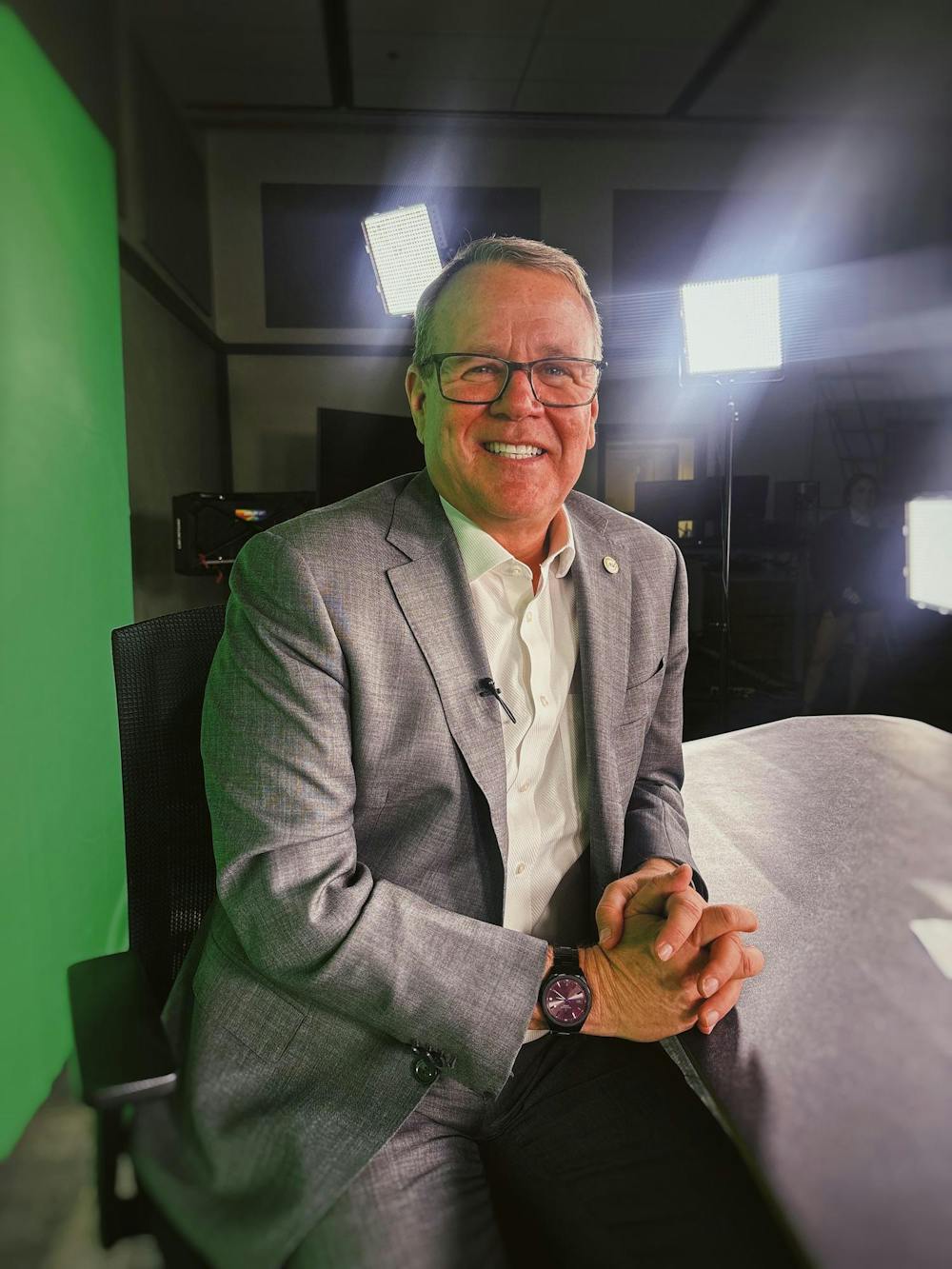
Eight years is more than just a tenure; it’s a generation of student life. President Andy Feinstein stepped into the role in 2018. As he prepares to step down in August of this year, he reflects on a career in higher education, the bittersweet reality of departure and the legacy he leaves behind in the heart of Greeley.
To the average student, a university president is often a distant figure, a name on a diploma or a face in a formal portrait. Feinstein broke that mold. Whether he was playing the cowbell with the Pride of the Rockies marching band or running alongside the football team, Feinstein made a point of being where the students were.

“I have incredible memories of my experiences, many of which involved students,” Feinstein noted. “Running out on the field at Nottingham, the fireworks at homecoming, those have always been wonderful memories for me.”
The visibility wasn’t just for show. For Feinstein, it was a genuine extension of his love for the institution. He spoke fondly of “bookending” the student experience, from helping nervous freshmen move their belongings into their dorm to shaking their hands on the graduation stage.
While the “cowbell-playing president” might be the image that sticks with students, his administrative achievements have fundamentally altered UNC’s trajectory. There have been several transformative pillars established during his eight-year watch.
For example, perhaps one of his most ambitious projects is the College of Osteopathic Medicine. The college addresses a physician shortage where only 35% of Colorado’s needs are met. The college is set to open in the fall of 2026 and, once fully operational, aims to enroll 150 graduate students each year to fill critical primary care needs.
Under Feinstein’s leadership, UNC received the Carnegie R2 Recognition. The university achieved the second-highest designation for research in the country. This elevated the institution’s national academic standing.
“I think I’ve created a roadmap, a path and opportunities for the next president to carry on with all the wonderful work that we’re doing here,” Feinstein said.
Feinstein acknowledged that priorities may shift under new leadership. He believes the “building blocks” of the "Rowing, Not Drifting 2030" strategic plan remain as true today as they were when they were drafted.
The phrase, “Rowing, not drifting,” is more than a catchy slogan; it is the title of a ten-year strategic plan. It is a living document designed to make UNC the institution Colorado looks to as the future of higher education. Developed through an extensive, collaborative process with campus stakeholders, the plan is divided into five phases: students first, empowering inclusivity, enhancing and invest, innovate and create, and connect and celebrate.
“The foundation, the building blocks are as true today as they were six years ago when it began,” Feinstein said.
Feinstein noted that the university is currently finishing the third of these five phases. He expressed hope that the momentum will carry through to 2030.
The journey has not always been smooth sailing. Feinstein has been transparent about the “enrollment pressures” and a funding environment where state support often fails to match the university’s ambition. In November of 2025, the university had to make the difficult decision to reduce its workforce by 85 positions. 50 of these positions included filled staff roles, but overall would reduce operating costs by approximately $8 million.
“None of these choices were made lightly,” Feinstein shared in a message to the campus. “By aligning our budget now, we are better positioned to preserve and strengthen the programs and services that directly support student success.”
Deciding to leave was not an overnight choice. Feinstein revealed it took several months of soul-searching and discussions with his wife, Kerry, before he felt ready to announce his departure.
“I thought, ‘I want to leave on top,’” Feinstein explained. “I want to leave at a moment in which this momentum could carry forward and allow another leader to even elevate the institution further than I’ve been able to.”
Despite the logic of the timing, the emotional weight of the decision remains. When asked about the transition, he admitted that it was a “bittersweet experience”. He recalled the Saturday morning after he made the official announcement to the Board of Trustees, waking up and wondering if he would feel remorse. Instead, he found a sense of peace, knowing the timing was right for both himself and the university.
In a moment that highlights the human side of high-level leadership, Feinstein shared a personal conflict regarding the upcoming spring commencement. For the first time in his eight-year tenure, the president will not be presiding over the graduation ceremony.
The reason? His daughter, Rachel, is graduating from college on the same weekend on the other side of the country.
“There is no way that I’m going to miss my daughter’s graduation,” Feinstein said.
While it pains him to miss seeing the Class of 2026 walk the stage, he will be trading his presidential robes for a cross-country road trip to celebrate his daughter’s achievement. After graduation, his daughter will be starting her own career in Colorado this summer.
As for what comes next, Feinstein isn’t rushing into a new office. Having recently climbed all of Colorado’s 58 “14ers," his immediate plans involve more of the great outdoors.
“My wife and I like to hike, we love to ski, we love to be outdoors,” he shared.
When asked how he hopes to be remembered, Feinstein didn’t cite the new buildings or the research designations.
“I hope that what people remember me for is someone who genuinely cared for UNC, its faculty, its staff and its students,” he said. “I love this place.”
It was clear that while Andy Feinstein is stepping down from the podium, his presence will likely still be felt, perhaps as a fan from the stands, still cheering for the team he helped lead through nearly a decade of change.

Women In Journalism: Fighting the Gender Credibility Gap

The Need for Political Science in a Politically Turbulent World


