

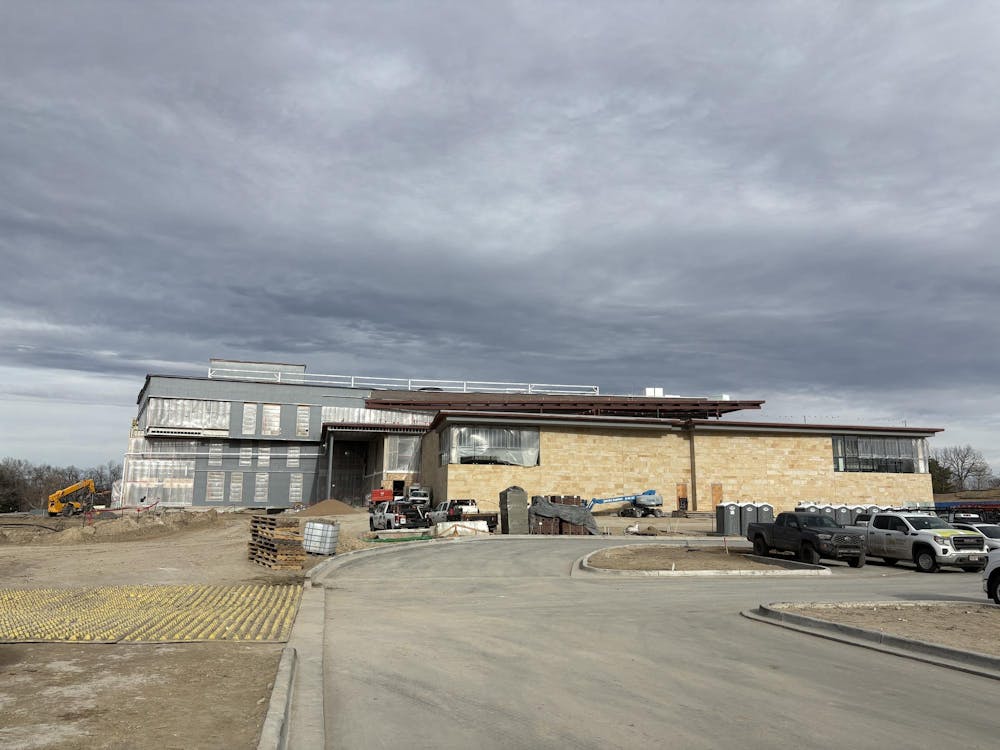
Construction continues on UNC’s new College of Osteopathic Medicine on West Campus, a $200 million project set to reshape the university’s future. Photo by Jaylen Lee
As dust and snow start to circle West Campus and the steel frame of the University of Northern Colorado’s new osteopathic medical school rises into the sky, it’s hard not to feel the energy around it. A $200 million project signals ambition and a new opportunity for UNC, something we haven’t had in years. For some students, it feels like the campus is finally stepping into a new era. For others, it makes them question, what happens to everything else?

The new medical school is, without question, a big deal. It positions UNC as a player in Colorado’s healthcare pipeline, draws attention from lawmakers and donors and promises academic opportunities the university has never been able to offer. Yet, some students feel like UNC is building toward the future, while students across campus are still dealing with real and immediate problems. There are outdated athletic facilities, shrinking program budgets and a student life experience that hasn’t kept pace with the university’s vision. That tension between what UNC is building and what UNC is currently neglecting sits at the center of this conversation.
Even with the concerns, many students agree the medical school is a major step in the right direction.
“It’s a smart investment for UNC,” said Jacob McDonough, a senior business marketing major. “A medical school brings in a new demographic of healthcare students. Not only will it help boost enrollment, but it will also bring money, attention and opportunities to northern Colorado that we don’t have right now. If the university manages it right, it could lift the whole campus.”
He’s not wrong. Colorado has been dealing with a doctor shortage for years, and there doesn’t seem to be a cure right now. By 2030, Colorado is expected to lose 2,424 doctors with 1,773 being primary care providers alone. Right now, state leaders have pushed for more homegrown physicians who can stay and serve rural communities, so UNC is answering that call with a strategic position. One that could help stabilize enrollment and elevate the university’s reputation beyond northern Colorado. For students in health-related fields, the excitement is even stronger.
“A medical school on campus makes so much sense,” said Samantha Rodgers, a sophomore nursing major. “For students like me going into health care, it opens doors we wouldn’t have otherwise. It feels like UNC is finally building toward something bigger.”
The long-term upside is real, but so are the concerns happening right now. UNC is pouring a large amount of resources into the new medical school, and that scale naturally draws attention to what isn’t receiving the same level of investment. Athletes see heavy machinery and chain-link fences across campus, only to enter facilities that haven’t seen meaningful upgrades in decades. Academic programs outside of health care watch their budgets tighten, and students who spend most of their time outside the classroom see campus life becoming increasingly unbalanced.
Some students aren’t necessarily against the medical school, they just don’t see it affecting them.
“It doesn’t really change anything for me, but it feels massive for no reason,” said Caden Knight, a senior business marketing major. “I get why it’s a big deal, but it’s not going to affect my classes or what I’m doing here. It just takes the beauty away from the campus right now, so I’m kind of neutral about it.”
That neutrality says a lot. When a project this big doesn’t feel connected to students outside one academic lane, the university risks creating a divide between who benefits now and who has to wait years for improvements. I don’t think the solution to this would be complicated. UNC can build its medical school and still support the students already here. These things aren’t mutually exclusive, but they require balance and a clear commitment to the rest of the campus.
The university doesn’t need to spend another $200 million on athletics or student life. But it does need to show students that while the medical school is rising, the rest of campus isn’t standing still. That means transparent planning. It means smaller, timely facility upgrades. It means supporting academic programs that make UNC a complete university and not just a future medical hub.
Students walk on campus every day, so they can notice when momentum is one-sided. They also notice when their university invests in them. If UNC can find that middle ground, the medical school won’t just be a win for future students, but a win for the whole campus community. For now, the medical school represents what UNC could become, the challenge is making sure the university doesn’t lose sight of what it already is.
Jaylen Lee is a senior journalism major at the University of Northern Colorado.

Women In Journalism: Fighting the Gender Credibility Gap

The Need for Political Science in a Politically Turbulent World


