

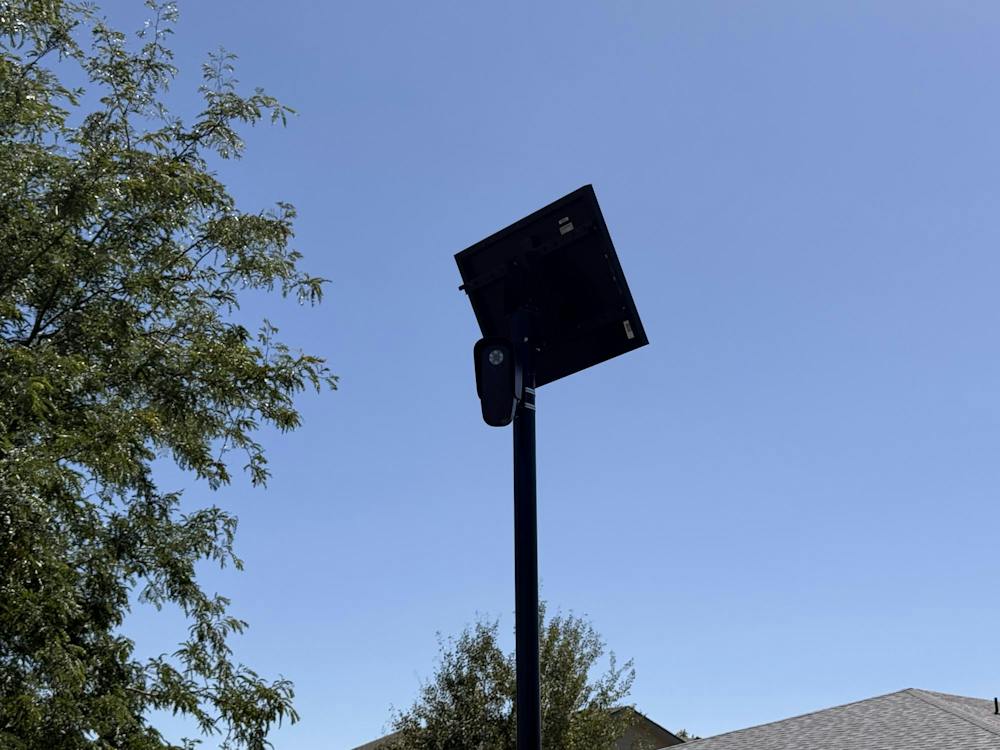
You have probably driven past one without thinking twice.
The small cameras sitting along Greeley roads may not look like much, but they have become a hot topic across the country, and not everyone is a fan.

So, what exactly are Flock cameras watching?
The Greeley Police Department uses Flock Safety cameras as part of its automated license plate reader (ALPR) program. According to the GPD, the cameras capture license plates and vehicle characteristics such as the vehicle’s make, model and color, along with the time and location of the detection.
The goal is simple: to give police another tool when a vehicle is connected to a crime, a missing person or another investigation.
But if it is that simple, why are people upset?
That is where the conversation gets a little more complicated.
Across the country, Flock cameras have sparked debates about privacy and government surveillance. Critics question how much information can be collected about people who have not committed a crime, who can access that information and what happens after it is collected. Research and reporting highlighted concerns about unauthorized searches and the possibility that officers could use ALPR systems to track people for reasons unrelated to legitimate police work.
In a social media post addressing concerns about the technology, the Greeley Police Department said, “Flock cameras are NOT for facial recognition, and do not detect people, gender or race.” The department also said the data collected by the cameras belongs to GPD and is “NEVER sold to third parties.” According to the post, the data is used for law enforcement and public safety purposes.
GPD also said in the post that Flock cameras are not used for immigration enforcement, traffic enforcement, harassment, intimidation or personal use.
Those concerns are part of a much larger national conversation, but they do not describe how Greeley says it uses the technology.
According to GPD, Flock data is retained for 30 days unless it needs to be preserved for a criminal case, evidence-retention requirement or another legal obligation.
The system also uses what GPD calls a “hotlist,” which can include vehicles associated with missing people, stolen vehicles or plates, warrants or violent offenses.
In its social media post, GPD explained that a hotlist is used to help recover missing people or intercept vehicles associated with a person of interest. The department said any hit on a hotlist must be verified by a person before action is taken.
And no, a camera alert does not automatically mean someone is guilty.
GPD describes an ALPR alert as an investigative lead, not proof of wrongdoing. Officers must verify the license plate and establish a legal basis for taking action.
Flock is also not the only ALPR system being used in Greeley.
As of March 2026, Greeley has 15 Rekor cameras, with data retained for 30 days. The department also has two stationary and two mobile ELSAG cameras. ELSAG data is retained for one year and is part of a network managed by Colorado State Patrol.
So, are Flock cameras watching Greeley?
In a way, yes.
They are recording vehicles that pass their cameras, including vehicles whose drivers are not suspected of a crime. That is why privacy advocates have questions about the technology.
But the other side of the conversation asks why police departments want the cameras in the first place. GPD says ALPR technology can help officers quickly locate stolen vehicles, missing people and vehicles connected to criminal investigations – information that can be especially important when time matters.
The question for Greeley residents may not simply be whether Flock cameras are good or bad, but it may be whether the safeguards surrounding them are enough.
For now, GPD says the cameras are a public-safety tool with limits on what information is collected, how it can be used and who can access it.
But as Flock cameras continue to spread across the country, the debate over privacy versus public safety probably is not going away anytime soon.

Something’s Brewing in Downtown Greeley

Women In Journalism: Fighting the Gender Credibility Gap


